


Social Learning LMS: How to Build a Culture of Peer Learning at Work
A practical playbook for L&D leaders on using a social learning LMS to build peer learning into everyday work, with the features and steps that make it stick.

Social Learning LMS: How to Build a Culture of Peer Learning at Work
TL;DR: A social learning LMS builds peer discussion, feedback, and knowledge sharing directly into your learning platform, rather than leaving it to scattered chat threads. To build a social learning culture, put conversation next to your content, make your experts visible, keep every answer searchable, and measure engagement the same way you measure course completions.
Key takeaways
- The 70-20-10 model, developed at the Center for Creative Leadership, estimates that only about 10% of workplace learning comes from formal courses, while roughly 20% comes from learning with and from other people.
- According to Harvard Business Review, when employees want to learn something new, 55% turn to their peers, second only to asking their manager.
- A social learning LMS captures that peer knowledge inside your learning platform and makes it searchable, instead of letting it disappear in chat.
- The best results come from designing social learning in, not bolting a forum on: conversation should sit next to the content, and your subject-matter experts should surface automatically.
- SuperPath includes social learning (Discussions) in its all-inclusive plan at AUD $5 per user per month, so there is no separate community tool to buy or manage.
What is a social learning LMS?
A social learning LMS is a learning management system with peer interaction built in: discussion forums, feedback, reactions, @mentions, and polls that live alongside your courses and pathways. It keeps the how-do-I-deliver-and-track-training job of an LMS, then adds the conversations that turn passive content consumption into active, shared learning across teams.
Standard LMS platforms are excellent at the structured side of learning: assigning courses, tracking completions, managing compliance records, and reporting to leadership. What many of them miss is the part where people actually learn from each other. A social learning LMS closes that gap. Rather than sending learners off to a separate forum, an intranet thread, or a Slack channel that nobody searches later, it brings the discussion into the same place as the content, so a question gets asked and answered exactly where it comes up.
It is worth keeping the category boundary clear. A social learning LMS is still an LMS: structured, assigned, and compliance-grade. That distinguishes it from a learning experience platform (LXP), which leans toward learner-led content discovery. The social layer is an enhancement to structured learning, not a replacement for it.
Why does social learning matter in the workplace?
Social learning matters because most workplace learning already happens between people, not in courses. The widely used 70-20-10 model, developed by researchers at the Center for Creative Leadership in the 1980s, proposes that roughly 70% of professional learning comes from doing the job, about 20% from other people, and only 10% from formal training. If you only invest in the 10%, you are ignoring where the majority of capability is built.
The evidence for peer learning is consistent. According to Harvard Business Review, when employees want to learn something new, 55% turn to their peers, making colleagues the second most common source after a direct manager. People reach for a trusted human before they reach for a course catalogue, so the organisations that capture and support those exchanges have a real advantage.
Recent research also points to how these habits reinforce one another. A 2025 cross-lagged study of 321 employees, published in Frontiers in Organizational Psychology, found that self-directed informal learning such as experimenting and reflecting reliably led people to pursue social learning such as seeking feedback and observing others. In other words, hands-on learning and peer learning feed each other, which is exactly why the two should sit side by side in your platform rather than in separate tools.
The business case is straightforward for L&D and HR leaders. LinkedIn's 2025 Workplace Learning Report, based on a survey of 937 L&D professionals, identifies career development and internal mobility, both of which depend heavily on learning from other people, as top priorities. Social learning is not a soft nicety. It is how skills spread, how new starters get productive faster, and how institutional knowledge stays in the building when people move roles.
How do you build a social learning culture with your LMS?
You build a social learning culture by designing the behaviour into everyday work, not by launching a forum and hoping people show up. The steps below move from where conversations happen, to who is recognised for helping, to how you keep the knowledge and prove the impact. Treat them as a sequence, because each one makes the next easier.
1. Put the conversation where the learning already is
The single biggest predictor of whether a discussion happens is how far someone has to travel to start it. If a question about a compliance module means opening a different tool, logging in, and finding the right channel, it will not get asked. Attach discussion directly to each course, pathway, event, and program, so the conversation is one click from the content that prompted it.
2. Seed the first conversations
Empty forums stay empty. When you launch a new pathway or cohort, post the first few questions yourself, or use AI to suggest conversation starters tied to the content. A discussion that already has two or three thoughtful threads feels alive and safe to join, whereas a blank page signals that nobody is home. The first fortnight sets the tone.
3. Make your experts visible
Recognition drives participation. Reactions, upvotes, @mentions, and polls do more than add friendliness: they surface the best answers and reveal who consistently helps others. Those people are your informal subject-matter experts, and making them visible to peers and managers both rewards the behaviour and tells everyone else who to ask. Social proof turns a quiet helper into a recognised go-to.
4. Set clear guardrails
Open does not mean unmanaged. Decide which discussions are open to everyone, which are invite-only, and which are locked to specific teams, and give admins control over who can post and what categories exist. Light-touch moderation, including automated safety checks, keeps conversations useful and on-topic without a human reading every message. Guardrails are what make managers comfortable letting go.
5. Turn discussions into a searchable knowledge base
The difference between chat and a knowledge base is search. Chat scrolls away and is gone; a good discussion should be findable a year later. Ensure full-text search runs across every title, post, and comment, so a question answered once becomes an answer available forever. This is where social learning compounds: every exchange makes the next new starter faster to onboard.
6. Tame the long threads with AI
A hundred-comment thread is a barrier, not a resource, if nobody will read it. Use AI to summarise long discussions into key points, conclusions, and the questions still open, so a busy manager can catch up in seconds. Removing the effort of catching up keeps senior people engaged, and their involvement is what gives a discussion its credibility.
7. Measure it like you measure completions
What gets measured gets managed. Track participation, questions answered, and the discussions linked to each program alongside your usual completion and compliance reporting. If social learning sits in a separate tool, you cannot see it next to learning outcomes, which is precisely why building it into the LMS matters. Report on it, and it earns its place in the L&D strategy.
What features should a social learning LMS have?
A social learning LMS should combine the structured core of an LMS with a genuine social layer. On the LMS side you still need course delivery, enrolment and assignment, completion and certification tracking, compliance records, reporting, and integration with your HRIS as the source of truth for people data. The social features are what you add on top, and the useful checklist is short.
Look for discussions attached to individual courses, pathways, events, and other learning objects, not just one central forum. Look for engagement mechanics that surface quality, such as reactions, upvotes, @mentions, and polls. Look for permission and moderation controls so you can decide who is in each conversation and keep it on-topic. Look for full-text search so conversations become a durable knowledge base. And increasingly, look for AI support, such as thread summaries and suggested conversation starters, so participation stays low-effort. Finally, check whether these capabilities are included or sold as a paid add-on, because that changes the real cost significantly.
How does SuperPath support social learning?
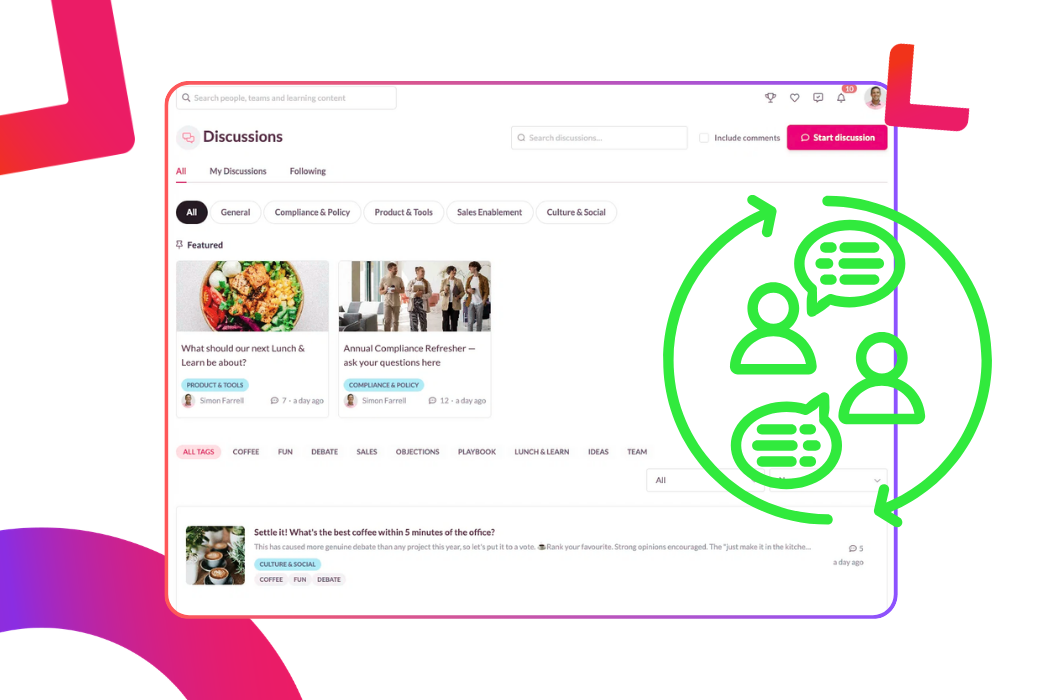
SuperPath is an all-inclusive Australian LMS, and social learning is built into it through Discussions, included in the standard plan rather than sold as an extra. Every course, pathway, event, and roadmap level gets its own Discussions tab, so learners ask and answer questions exactly where they come up, and you can start a free-standing discussion on any topic too. There is no separate forum to manage and no second tool to log into.
The social mechanics are all there: emoji reactions, upvotes, @mentions, and built-in polls keep conversations moving and push the best answers to the top, which quietly reveals your subject-matter experts to peers and managers. Admins decide whether a discussion is open to everyone, invite-only, or locked to specific teams, and built-in moderation with AI safety checks keeps things useful. AI also summarises long threads into key points and open questions, and can suggest conversation starters when you link a discussion to a course, so a new cohort feels active from day one. Because discussions do not disappear, full-text search across every title, post, and comment turns your team's conversations into a knowledge base that grows more valuable over time. Discussions is live now, and you can read the full launch announcement or see the feature in detail on the SuperPath Discussions page.
The commercial point matters as much as the feature list. Many platforms treat community and social learning as a premium module on top of a base per-user fee. SuperPath bundles it: social learning, the AI Course Builder, the Australian compliance content library, premium HRIS integrations, and local support and implementation are all included at AUD $5 per user per month, scaling for larger organisations. The HRIS, such as Worknice, stays the source of truth for people data; SuperPath syncs employees, roles, and org structure in, and writes completion and compliance status back.
What mistakes should you avoid?
The most common mistake is bolting on a standalone forum and treating the job as done. A forum that lives away from the content, with no seeding, no recognition, and no search, becomes a ghost town within a month and quietly confirms to leadership that "our people just are not into it". The behaviour was never the problem; the design was. Build the conversation into the flow of learning instead.
Two more traps are worth naming. First, leaving discussions unmoderated and unstructured, which lets quality drift and makes managers reluctant to participate. Set permissions and light moderation from the start. Second, keeping social learning in a tool that does not connect to your learning records, so you can never show its impact next to completions and compliance. If you cannot measure it, you cannot defend the investment, and an undefended programme is the first thing cut.
About the author
Barry Heath is Head of Growth and Partnerships at SuperPath, an all-inclusive Australian LMS for mid-to-large organisations. He works with L&D, HR, and training leaders on how to consolidate content, authoring, and social learning into a single platform, and writes about the practical side of choosing and running learning technology in Australia.
Sources
- Center for Creative Leadership. "The 70-20-10 Rule for Leadership Development." Center for Creative Leadership. https://www.ccl.org/articles/leading-effectively-articles/70-20-10-rule/
- Harvard Business Review. "How to Help Your Employees Learn from Each Other." Harvard Business Review, November 2018. https://hbr.org/2018/11/how-to-help-your-employees-learn-from-each-other
- Seifert, Andreas. "Self-based learning fuels social-based learning, but not the other way around: insights from a cross-lagged panel study on informal workplace learning." Frontiers in Organizational Psychology, August 2025. https://www.frontiersin.org/journals/organizational-psychology/articles/10.3389/forgp.2025.1580957/full
- LinkedIn Learning. "2025 Workplace Learning Report." LinkedIn, 2025. https://learning.linkedin.com/resources/workplace-learning-report
- SuperPath. "Pricing." SuperPath, 2026. https://www.superpath.io/pricing
Frequently asked questions
A social learning LMS is a learning management system with peer interaction built in, such as discussion forums, feedback, reactions, and @mentions, sitting alongside courses and pathways. It keeps the delivery, tracking, and compliance strengths of an LMS while adding the conversations that help people learn from each other, all in one platform rather than separate tools.