


How Do You Connect Training, Rostering and Compliance for Aged Care and NDIS Teams?
Connect your LMS to rostering and HR so aged care and NDIS compliance runs itself: the right training auto-assigns on hire, completions write back to one record, and only verified, current staff get rostered.
How Do You Connect Training, Rostering and Compliance for Aged Care and NDIS Teams?
TL;DR You connect them with an LMS that integrates with the systems already running your workforce. When a worker is hired in your HRIS, the right mandatory training assigns automatically, completions write back to one record, and only verified, current staff get rostered. SuperPath does this with integrations, features, and a compliance library included at AUD $5 per user per month.
Key takeaways
- The strengthened Aged Care Quality Standards have applied since 1 November 2025, and they make a documented workforce capability system a condition of provider registration, so your training records are now part of your audit evidence.
- The NDIS Worker Orientation Module is mandatory for staff of registered NDIS providers under the Human Resources requirement of the NDIS Practice Standards, and auditors ask to see the completion certificates.
- Most compliance failures in care are not training gaps, they are tracking gaps: the training happened, but the record sits in a different system from the roster and the HR file.
- An LMS that integrates with your HRIS and rostering tool auto-enrols new starters by role, writes completions back to one record, and flags expiring certificates before they lapse.
- SuperPath bundles the LMS, every integration, the AI Course Builder, and 15 Australian compliance courses at AUD $5 per user per month, with specialist NDIS and aged care content available through content partners such as Wyzed.
What does it mean to connect training, rostering and compliance in care?
It means your learning system talks to the systems that already run your workforce: your HRIS, where people data lives, and your rostering tool, where shifts are built. Instead of managing enrolments and certificates by hand, training assigns, tracks and reports itself as staff are hired, change roles, and get scheduled.
For most aged care and NDIS providers, these three jobs live in three different places. People data sits in an HRIS or payroll system. Shifts are built in a rostering or workforce management tool. Training and certificates live in a learning management system (LMS), a spreadsheet, or a filing cabinet. Each system is fine on its own. The risk lives in the gaps between them.
A connected setup closes those gaps. When a new support worker is added to your HRIS, their role flows into the LMS and the correct induction and mandatory training assigns automatically. When they finish, the completion writes back so a manager can see, in one place, that the worker is current. When a roster is built, only staff with valid clearances and up to date training are eligible for the shift. Nobody re-keys data between systems, and nothing falls through.
What training do aged care and NDIS providers actually have to track?
Aged care and NDIS providers carry overlapping but distinct obligations. Aged care providers must evidence competency against the strengthened Quality Standards. NDIS providers must show workers have completed mandatory orientation and hold valid screening. Both sectors require role-based training, expiry tracking, and audit-ready records that prove the work was done, not just hosted.
In aged care, the bar moved with the Aged Care Act 2024 and the strengthened Quality Standards. According to the Aged Care Quality and Safety Commission, registered providers must comply with the strengthened Standards as a condition of registration, and that includes a workforce capability system covering training, supervision, and performance. In practice that means role-based modules on person-centred care, dementia, the Aged Care Code of Conduct, the Serious Incident Response Scheme, restrictive practices, and emergency response, with records to match.
In the NDIS, the headline requirement is the NDIS Worker Orientation Module, "Quality, Safety and You". According to the NDIS Quality and Safeguards Commission, the module explains workers' obligations under the NDIS Code of Conduct and is mandatory for staff of registered providers under the Human Resources requirement of the NDIS Practice Standards. It runs about 90 minutes, the certificate does not expire, and auditors will ask to see it. It sits alongside, but separate from, the NDIS Worker Screening Check, which is a background check that must be verified before a worker starts unsupervised work.
This is the part many platforms leave to you. A general LMS can host a course, but it does not arrive with sector-specific care training inside it. SuperPath includes 15 Australian compliance courses for all-industry obligations, and for clinical care it makes specialist content from publisher partners, such as Wyzed's NDIS and aged care libraries, available natively in the platform, so the content and the system that tracks it come together.
Why do disconnected systems create compliance risk?
Because care workforces turn over constantly, and manual tracking cannot keep up. Every new hire, role change, and certificate renewal is another chance for a record to be missed. When training data lives apart from the roster and the HR file, "is this worker current?" becomes a question you answer by hand, usually under audit pressure, instead of one the system answers for you.
The scale is the issue. The Aged Care Worker Survey 2024, run by the Department of Health, Disability and Ageing, heard from more than 21,000 workers, of whom 72% were personal or home care workers. Add the sector's well-documented turnover, recorded across successive National Aged Care Workforce Census collections, and you have a workforce in near-constant re-onboarding. NDIS providers face the same churn across a large casual and part-time support workforce.
Manual processes break at that volume. An administrator creating accounts, assigning courses, and chasing completions one worker at a time will always be behind. The failure mode is rarely that training did not happen. It is that the proof is scattered, a certificate is buried in an inbox, or a worker was rostered after their clearance lapsed because nothing flagged it. Those are the findings that surface in an audit, and they are tracking problems, not teaching problems.
How does SuperPath connect your LMS to your HRIS and rostering?
Your HRIS stays the source of truth for people data. SuperPath syncs employees, roles, and org structure in from it, auto-assigns the right training to each role on hire, and writes completion and compliance status back. Your rostering tool can then use that status, so scheduling and training stop being separate worlds. The LMS integrates with your HRIS, it does not replace it.
The HRIS boundary is the one to get right. People records, including who works for you, their role, and their employment status, belong in the HRIS. The LMS reads that information, acts on it, and reports back. It never tries to own employee data. So when someone is hired in your HR system, the LMS enrols them in the correct pathway automatically, and when they complete it, the HR record reflects that they are compliant.
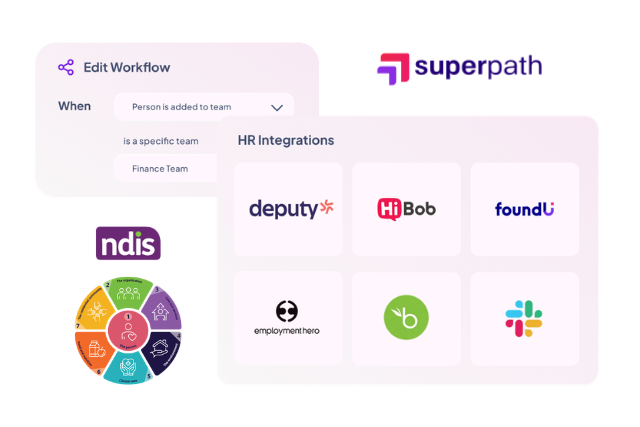
This is what SuperPath is built for. It connects to the workforce systems Australian care providers already run, including Deputy for rostering, and HRIS platforms such as Worknice, Employment Hero, HiBob, and foundU. Crucially, every integration is included in the subscription, not sold as a paid connector on top. The practical payoff for a care operator is concrete: a new personal care worker added in the HRIS is auto-enrolled in their induction the same day, their completion is visible to their manager without anyone reconciling two systems, and an expiring certificate is flagged before it becomes a rostering problem. To see which HR systems connect cleanly, read our guide to the best HRIS platforms in Australia for LMS integration.
What should an all-inclusive LMS include for aged care and NDIS?
It should include the things most platforms charge extra for: the integrations that connect it to your HRIS and rostering, an authoring tool to build your own courses, a baseline compliance library, and local support and implementation. When those are bundled, your cost is predictable and the system is connected on day one, rather than a base licence with a stack of add-ons to price and assemble.
This is the difference that matters when you compare options. Many LMS platforms publish a low base price, then charge separately for content, for an authoring licence, for premium integrations, and for implementation. By the time the system actually does what an aged care or NDIS provider needs, the real cost is several line items higher than the headline.
SuperPath takes the opposite approach. The LMS, all its features including the AI Course Builder, every integration, and a library of 15 Australian compliance courses are included at one transparent price of AUD $5 per user per month. Specialist clinical content, such as Wyzed's NDIS and aged care libraries, is added as a content bolt-on and delivered natively inside the same platform, connected to your HR, rostering, and compliance tools. You keep the workforce systems you already trust, and the learning layer that sits on top is connected and costed up front.
How do you set up an integrated training and compliance system?
Start from your systems of record, not from a feature list. Confirm which HRIS holds your people data and which tool builds your rosters, because those stay in place. Then choose a learning platform that integrates with both, includes or connects to the care content you need, and tracks completions and expiries against each role. The goal is one compliance picture, not four disconnected ones.
A short checklist for aged care and NDIS providers evaluating an integrated setup:
- Does the LMS integrate two-way with your HRIS, so people data syncs in and completion status writes back, and is that integration included rather than charged as an extra?
- Can it connect to your rostering tool, so only current, verified staff are rostered?
- Does it auto-assign mandatory training by role, and flag expiring certificates before they lapse?
- Can it produce the audit-ready report a quality assessor or NDIS auditor will ask for, mapped to the relevant Standards?
- Does it give you specialist NDIS and aged care content, or connect cleanly to a partner library that does?
SuperPath was built around this for the Australian market, which is why the integrations, features, and a compliance library are bundled rather than billed separately, and why specialist care content is available through partners like Wyzed. The broader point holds whichever platform you choose. In a sector defined by turnover and tightening Standards, the providers who stay audit-ready are the ones whose training, rostering, and compliance talk to each other.
Frequently asked questions
Is the NDIS Worker Orientation Module mandatory for support workers?
It is mandatory for staff of registered NDIS providers. According to the NDIS Quality and Safeguards Commission, the "Quality, Safety and You" module is required under the Human Resources element of the NDIS Practice Standards. It takes about 90 minutes, the certificate does not expire, and auditors ask to see completion records as evidence.
What are the strengthened Aged Care Quality Standards and when did they start?
The strengthened Aged Care Quality Standards sit under the Aged Care Act 2024 and have applied since 1 November 2025. According to the Aged Care Quality and Safety Commission, compliance is a condition of provider registration and includes a workforce capability system. In practice, your training records become part of the evidence assessors review.
Can SuperPath connect to rostering tools like Deputy?
Yes. SuperPath integrates with Deputy for rostering, alongside HRIS platforms such as Worknice, Employment Hero, HiBob, and foundU, with every integration included in the subscription. For care providers, this means workers with lapsed clearances or incomplete mandatory training can be identified before they are rostered onto a shift.
Does connecting an LMS replace my HRIS?
No. The HRIS stays the source of truth for people data: employees, roles, and org structure. The LMS syncs that information in, assigns and tracks training, and writes completion and compliance status back. It integrates with your HRIS rather than replacing it, so you keep one set of accurate people records, not two.
How much does an LMS cost for an aged care or NDIS provider in Australia?
SuperPath's LMS is AUD $5 per user per month, which includes every feature, all integrations, the AI Course Builder, and 15 Australian compliance courses. Specialist clinical content, such as Wyzed's NDIS and aged care libraries, is added as a content bolt-on. Pricing models vary widely between vendors, so confirm what is included before deciding.
About the author
Barry Heath is Head of Growth and Partnerships at SuperPath, an Australian all-inclusive LMS for mid-to-large organisations. He works with content and HR technology partners, including Wyzed, to help aged care, NDIS, and other compliance-heavy sectors connect their training, rostering, and HR systems into a single, audit-ready compliance picture.
Sources
- Aged Care Quality and Safety Commission. Strengthened Aged Care Quality Standards. agedcarequality.gov.au
- Australian Government Department of Health, Disability and Ageing. Aged Care Worker Survey 2024 report. November 2024. health.gov.au
- NDIS Quality and Safeguards Commission. NDIS Code of Conduct. ndiscommission.gov.au
- NDIS Quality and Safeguards Commission. Worker Orientation Module: Quality, Safety and You. ndiscommission.gov.au
- SuperPath. Pricing. superpath.io/pricing
- SuperPath. Integrations. superpath.io/integrations
- Wyzed. NDIS training library. wyzed.com/ndis-aus
- Wyzed. Aged care training library. wyzed.com/aged-care