


The LMS That Integrates With BambooHR: Two-Way Sync, Australian Courses and Training Records That Write Themselves
SuperPath is the LMS that integrates with BambooHR: people sync straight away by webhook, leavers are disabled, completed learning is filed in the BambooHR training record, and Australian courses are included at AUD $5 per user per month.

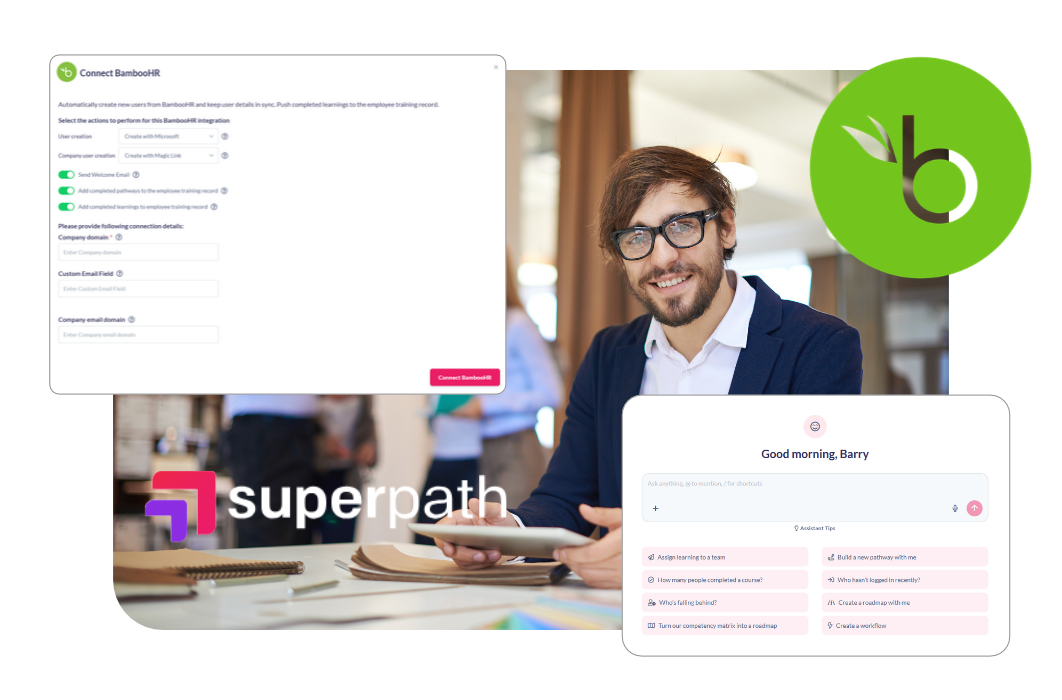
TL;DR: SuperPath is an Australian LMS that integrates with BambooHR. Employee changes reach SuperPath straight away, new starters get accounts, leavers are disabled, and divisions and departments become teams. Completed pathways, assignments, events and forms are written back to each employee's BambooHR training record. Australian courses are included and fully editable, at AUD $5 per user per month.
Key takeaways
- Since October 2025, every BambooHR plan includes compliance training powered by EasyLlama: 1 course on Core, 15 on Pro and 300+ on Elite, at no extra cost on top of the plan.
- That training is built for a global, US-led market. The regulations BambooHR names in its launch are OSHA, HIPAA, GDPR and the EU AI Act, and its own course page says video and SCORM uploads are "not yet supported".
- The SuperPath BambooHR integration syncs people from BambooHR straight away by webhook, disables leavers automatically, and files completed learning in the employee's BambooHR training record with a link back to SuperPath. There is no API key to manage.
- Moving from BambooHR Pro to Elite to unlock the 300+ course library costs USD $8 more per employee per month at list price. SuperPath costs AUD $5 per user per month, with a full LMS, Australian course libraries, AI authoring and the integration included.
- Richard Crookes Constructions, a family-owned builder with more than 900 employees, and Who Gives A Crap, the Melbourne-founded B Corp, both run SuperPath alongside BambooHR.
Does BambooHR have an LMS?
BambooHR does not have a full LMS, but since October 2025 every plan includes compliance training powered by EasyLlama. Core includes one harassment prevention course, Pro includes 15 courses and Elite includes more than 300. HR teams assign and track those courses inside BambooHR. Building, editing and certifying your own training still needs a learning management system.
BambooHR is one of the most widely used HR platforms in the world. According to BambooHR, it has more than 33,000 customers and 3 million users. Plenty of Australian organisations run on it, including two of SuperPath's flagship customers, because it gives growing and globally distributed teams clean people data without an enterprise HR suite.
On 21 October 2025, BambooHR announced its partnership with EasyLlama, a US compliance training company. BambooHR's chief product officer described it as a way to help customers "protect their people, their reputation, and their future, at no extra cost." The pricing page now lists the training against each plan:
BambooHR plan | List price (USD per employee per month) | Training included, powered by EasyLlama |
|---|---|---|
Core | $10 | 1 course: foundational harassment prevention |
Pro | $17 | 15 compliance courses |
Elite | $25 | 300+ courses |
Credit where it is due: this is a genuinely useful addition for an HR platform, and "no extra cost" is a real benefit. Admins can assign courses by role, department or location, and BambooHR handles reminders and recurring training. For a lot of BambooHR's customers it will be enough.
It is not, however, a learning management system in the sense an Australian L&D or HR team means it. An LMS is the system of record for structured learning: it lets you build and edit your own courses, run onboarding and role-based pathways, assess people properly, manage certificates that expire, and report on all of it for an audit. BambooHR's training feature is a compliance course catalogue that lives inside the HRIS. That distinction matters most in three places: where the content comes from, whether you can change it, and what happens with everything that is not on the menu.
Is BambooHR's built-in training enough for Australian compliance?
For many Australian organisations, no. BambooHR's included training is designed for a global, US-led market, and the frameworks it names are American and European. Australian obligations such as WHS, the Privacy Act and the Respect@Work positive duty need Australian content. Courses also cannot be rewritten around your own policies, sites and risks.
Start with the content. In its launch announcement, BambooHR frames the course library around OSHA, HIPAA, GDPR and the EU AI Act. Those are US and EU frameworks. EasyLlama does publish Australian versions of its harassment prevention training, one for employees and one for supervisors, and BambooHR describes the Pro bundle as tailored by country. What I could not find, in either BambooHR's pages or EasyLlama's published course catalogue, was Australian-specific content on work health and safety, the Privacy Act, modern slavery, child safe standards or the positive duty to prevent sexual harassment.
Those are not optional topics in Australia. Under the model Work Health and Safety Regulations, regulation 39 requires training to be "suitable and adequate" for the work and its risks. Safe Work Australia's model Code of Practice How to Manage Work Health and Safety Risks goes further: "It is insufficient to simply give a worker the procedure and ask them to acknowledge that they understand and are able to perform it." The positive duty under the Sex Discrimination Act was introduced in December 2022, and the Australian Human Rights Commission's powers to enforce it "commenced on the 12th of December 2023". A generic, US-built course is a weak answer to a regulator asking whether your training was suitable for your workers and your risks.
Then there is customisation. BambooHR lets you "add your own PDFs, documents, and policies directly into EasyLlama's expert-built courses", and to create custom training tasks from files. But on its own compliance training page, BambooHR is clear that "video and SCORM files" are "not yet supported (but coming soon)". So if you have existing eLearning, induction videos or a SCORM package from a content partner, the built-in training cannot run it today. And BambooHR's EasyLlama services addendum grants a licence for internal use while EasyLlama keeps ownership of the course content, so attaching your policy to a course is not the same as rewriting the course around it.
The same addendum also says the course content is provided "as is" and disclaims "any warranty that the course content satisfies any particular regulatory or legal requirement applicable to customer". To be fair, that is standard wording for third-party training content, and no vendor can take your legal duties off you. But it makes the practical point well: the employer carries the obligation, so the employer needs content it can check, localise and change.
What is the SuperPath BambooHR integration and how does it work?
The SuperPath BambooHR integration connects BambooHR, the HRIS, with SuperPath, an all-inclusive Australian LMS. BambooHR stays the source of truth for people, and changes reach SuperPath straight away. SuperPath creates accounts, assigns the learning each role needs, and files every completion back in the employee's BambooHR training record, so HR never retypes one.
The loop runs in four steps:
- A person is added or changed in BambooHR. A webhook sends the change to SuperPath straight away: name, email, job title, country and state, manager, division, department and employment status.
- SuperPath creates their account and enrols them. Divisions and departments become SuperPath teams, and pathways assign the onboarding, compliance and role-specific learning their team requires.
- They complete the learning. Courses, assessments, forms and events are completed on web or mobile, and workflows handle the reminders and escalations so nobody has to chase.
- The result is written back. Completed pathways and learning are filed in the employee's BambooHR training record, each with its completion date and a link back to SuperPath, where HR and managers already look.
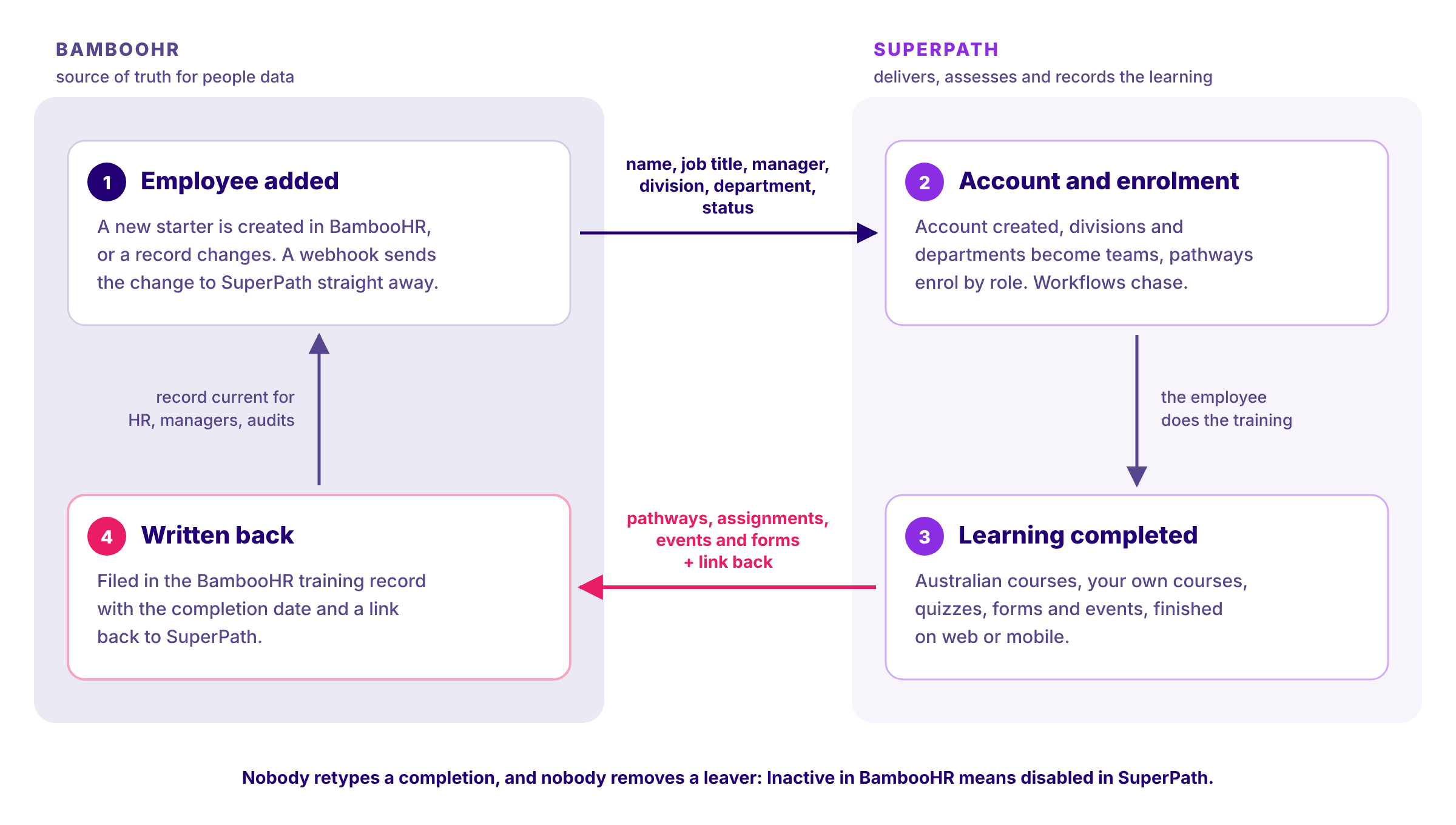
The loop also closes at the other end. When someone is marked Inactive in BambooHR, their SuperPath account is disabled automatically, and their learning history is kept. Nobody has to remember to remove a leaver from the LMS.
The boundary is deliberate. SuperPath does not store contracts, run payroll or own employee records. It works the same way as the SuperPath Employment Hero integration, the HiBob integration and the Deputy integration: the HR platform owns the person, SuperPath owns the learning, and the outcome goes home to the HR record.
What data syncs between BambooHR and SuperPath?
Name, email, job title, country and state, manager, division, department and status sync from BambooHR to SuperPath as soon as they change. Completed pathways, assignments, events and forms sync back to the employee's BambooHR training record, each with its completion date and a link to SuperPath. Two settings control the write-back.
This is the detail most BambooHR integration pages skip, so here it is at the level of the actual settings, drawn from SuperPath's BambooHR configuration guide, updated in November 2026, and the BambooHR integration page.
How it connects. In the guide's words, "There is no API key to create or copy". A BambooHR admin signs in and approves the SuperPath app, and SuperPath creates the webhook in BambooHR itself. When an employee is added or changed, "the change is sent to SuperPath straight away", rather than waiting for a nightly batch.
Coming from BambooHR, SuperPath keeps these details in sync:
- Name, email and job title. Email is the work email, or a custom BambooHR field you nominate if some staff use a different address.
- Country and state, which matters when obligations differ between jurisdictions.
- Manager, taken from the BambooHR supervisor, so managers can see their own team's training.
- Division and department, which become teams. "Each Division becomes a Team, and each Department becomes a Team inside its Division." When someone changes department, they move team, and any teams you created yourself in SuperPath are left alone.
- Status. Only Active employees are created. When someone becomes Inactive they are disabled in SuperPath with their learning history kept, and if they return and become Active again, they are re-enabled.
People are matched by email, so connecting BambooHR to an existing SuperPath account links the people already there rather than duplicating them.
Going back to BambooHR, two settings control what is written to the employee's training record:
Setting | What is written back |
|---|---|
Add completed pathways to the employee training record | Each completed pathway |
Add completed learnings to employee training record | Completed assigned learning, including individual pathway steps |
SuperPath files the records under four training categories in BambooHR: Learning Pathways, Learning Assignments, Learning Events and Learning Forms, creating any that do not exist yet. Three details separate this from a basic connector:
- Every record carries a link back to SuperPath, alongside the learning's name, description and completion date. Anyone reading the BambooHR record can click through to the learning itself.
- The two systems cannot drift apart. If a completed learning is deleted in SuperPath, its training record is removed from BambooHR too.
- History comes across safely. Learning Resync sends any completed learning that has not yet reached BambooHR, and "running it again does not create duplicates". So switching the integration on does not leave years of training sitting outside the record.
Individual people and records can be refreshed with a Resync with BambooHR option, every sync is recorded in Integration Logs, and a Test Integration button checks the connection.
How people get their accounts is chosen when you connect, and there are seven options because workforces differ:
- Invite Users: an invitation goes out and the person appears once they accept. The right choice if you use Google or Microsoft single sign-on.
- Create with Magic Link: the account is created and the person signs in from an emailed link, with no password to remember. Often the difference between a rollout that reaches site and warehouse teams and one that stalls at head office.
- Create with Password, Google, Microsoft or SAML: for organisations with an established identity setup.
- Manual: no accounts are created automatically, but people you add yourself are kept in sync with BambooHR.
There is also a company user creation setting. If some staff use your company email domain and others do not, you can give each group its own sign-in method, which is exactly the split you see in construction, retail and hospitality businesses where head office and frontline staff work differently.
Two limits are worth knowing before you start. An employee without an email address in BambooHR cannot be created, and is logged as a failure for you to fix. And a manager is only linked if they are already in SuperPath, so if a manager joins after their team, running Refresh people and teams fills the gap.
Why does writing training back to BambooHR matter?
Writing training back to BambooHR matters because the employee record is where HR, managers and auditors look first. If completions live only in the LMS, someone ends up exporting and retyping them. When the LMS writes them back automatically, the BambooHR record is current by default, and your training evidence stops depending on someone's memory.
Do the arithmetic for a 300-person business with five required items each. That is 1,500 training records to create, and if most renew annually, 1,500 more every year, each needing the right course and the right date. Manual entry at that volume does not fail loudly. It fails quietly, one missing record at a time, until an incident or an audit finds the gap.
An automatic record is also a better record. Because each one SuperPath writes carries a link back to the learning itself, the BambooHR entry is not just a line saying someone finished something. It points to what they completed, so the evidence is one click from the employee file.
Record-keeping is an obligation, not housekeeping. According to Safe Work Australia's guidance on information, training and instruction at major hazard facilities, "keeping good records of training provided to workers and visitors is an essential element of an effective training system". Some hazards carry specific retention periods: under the model WHS Regulations, asbestos training records must be kept while the worker carries out the work and for five years after, and confined spaces training records for two years.
The Fair Work Commission has also been clear about what does not count. In Stutsel v Linfox Australia Pty Ltd [2011] FWA 8444, the tribunal said of an employer relying on its induction and a handbook: "In the current electronic age, this is not sufficient." A policy in a folder is not training. Learning that was assigned, completed, assessed and recorded is, and the record belongs on the employee's file.
How does SuperPath compare with BambooHR's built-in training and other BambooHR LMS integrations?
BambooHR's built-in training is a compliance course catalogue included in your HR plan. Global LMSs such as TalentLMS and Absorb integrate with BambooHR but price content separately and carry no Australian compliance library. SuperPath is a full LMS with Australian course libraries, AI authoring and BambooHR write-back included in one price.
Capability | BambooHR Compliance Training (EasyLlama) | TalentLMS | Absorb LMS | SuperPath |
|---|---|---|---|---|
What it is | Compliance training inside the HRIS | Global LMS, popular with smaller teams | Global mid-market and enterprise LMS | Australian all-inclusive LMS |
Content approach | 1, 15 or 300+ EasyLlama courses depending on BambooHR plan | TalentLibrary is an add-on with no published price | Amplify content libraries, sold in tiers | Included libraries: Australian compliance, essential workplace skills, AI readiness, retail and hospitality |
Australian compliance content | Australian harassment prevention versions; no Australian WHS, privacy or positive duty courses found | None claimed | None claimed | Included and editable |
Your own content | PDFs and Office files; video and SCORM not yet supported | Built-in course builder and SCORM | SCORM and xAPI | AI Course Builder, SCORM and more, all included |
BambooHR sync | Native | Employee data in; completions shown on the BambooHR profile | Two-way, about every 30 minutes, set up by Absorb support | Two-way: people sync straight away by webhook, leavers disabled, completed learning filed back in four training categories |
Published pricing | Included in BambooHR plans (USD $10 to $25 per employee per month) | From USD $119 a month, by user band | Not published | AUD $5 per user per month, everything included |
Read fairly, that table says BambooHR's built-in training is the most convenient option for basic, generic compliance, and the global LMSs are capable platforms with mature BambooHR connectors. TalentLMS is a good fit for smaller teams. Absorb is a strong enterprise platform, and its BambooHR sync is genuinely two-way.
The separation comes in three places. First, content: SuperPath includes Australian compliance courses covering work health and safety, privacy, cyber security, bullying and harassment, anti-discrimination, modern slavery, psychological safety, child safety and the Respect@Work positive duty, alongside essential workplace skills, AI readiness modules and industry bundles such as Retail Ready and Hospitality. Second, every one of those courses is editable in the AI Course Builder, so you can deploy it as it stands or rewrite it around your own policies, branding and examples in minutes. Third, the price is one published number, in Australian dollars, with no add-ons.
How much does an LMS for BambooHR cost?
BambooHR's training is included in its plans, so the real cost question is what it takes to get the library you need. Moving from Pro (15 courses) to Elite (300+) adds USD $8 per employee per month at list price. SuperPath costs AUD $5 per user per month, with a full LMS, Australian libraries, AI authoring and the integration included.
BambooHR publishes its prices in US dollars. On its plan cards Core is USD $10, Pro USD $17 and Elite USD $25 per employee per month (its FAQ quotes USD $17.50 for Pro), with volume discounts applied automatically and an extra 15% off for not-for-profits. Here is what the learning decision costs at list price, per year:
Headcount | BambooHR Pro to Elite upgrade (USD) | BambooHR Core to Elite upgrade (USD) | SuperPath, all inclusive (AUD) |
|---|---|---|---|
100 | $9,600 | $18,000 | $6,000 |
200 | $19,200 | $36,000 | $12,000 |
500 | $48,000 | $90,000 | $30,000 |
Two caveats keep that table honest. The BambooHR figures are in US dollars, so the gap is wider once converted to Australian dollars, but they are list prices before BambooHR's volume discounts. And Elite is not only a training upgrade: it also adds compensation planning, advanced analytics and premium services, so if you want those anyway, the library comes along with them.
The point is narrower than "BambooHR is expensive". BambooHR is excellent value as an HRIS, and you keep it. The point is that upgrading your HR plan to buy a bigger US-built course catalogue is an expensive way to solve an Australian learning problem. For AUD $5 per user per month, SuperPath gives you the LMS, the Australian libraries, the authoring tool, the BambooHR integration, local support and implementation. Larger teams and not-for-profits can request tailored pricing, and there is a 30-day free trial.
If you want to know how other Australian LMS pricing models compare, see our guide to how much an LMS costs in Australia.
Which Australian organisations use SuperPath with BambooHR?
Two of SuperPath's flagship Australian customers run SuperPath alongside BambooHR: Richard Crookes Constructions, a family-owned builder with more than 900 employees, and Who Gives A Crap, the Melbourne-founded B Corp. In both, BambooHR holds the people data and SuperPath delivers, tracks and records the training.
Richard Crookes Constructions has been delivering projects since 1976. According to the company, it is 100% Australian and family owned, employs more than 900 people, turns over $1.9 billion and has completed more than 1,380 projects across sectors from health and education to defence, infrastructure and data centres. Construction is where training evidence is least forgiving: inductions, high-risk work, site-specific procedures and renewals all have to be current, and provable, for every person on every project.
Who Gives A Crap started in Melbourne and donates 50% of its profits to global causes, with more than $20 million donated so far according to the company. Its team spans the globe, which makes BambooHR a natural fit as the HRIS, and makes it important that learning stays consistent and on brand wherever people sit.
Very different businesses, the same pattern. Neither replaced its HRIS to fix training, and neither needed to. They kept BambooHR as the home of their people data and added an LMS that plugs into it.
How do you set up the SuperPath BambooHR integration?
Setting up the integration is a short job and needs no API key. A SuperPath Owner or Admin enters your BambooHR company domain, chooses how accounts are created and which records write back, then signs in to BambooHR as an Admin to approve the SuperPath app. SuperPath creates the webhook, and one refresh imports everyone.
The steps, from the SuperPath help centre:
- Find your BambooHR company domain. It is the part of your BambooHR address before .bamboohr.com: if you sign in at customer.bamboohr.com, your company domain is "customer".
- Open the BambooHR card in SuperPath. Go to Settings, then Integrations, and choose Connect BambooHR. Enter the company domain, plus a custom email field if some staff should sync with an address other than their work email.
- Choose your user creation method, from Invite Users through to Magic Link, Google, Microsoft or SAML, and set a company email domain if staff on it should sign in differently. The guide recommends leaving the welcome email off until you are ready to launch.
- Turn on the training record settings you want: completed pathways, completed learnings, or both.
- Sign in to BambooHR and approve the SuperPath app. SuperPath then creates the webhook automatically.
- Run Refresh people and teams, then Learning Resync, to import your existing employees and send any past completions to BambooHR. Test Integration confirms everything is connected.
Start small. Assign a single compliance pathway to one department, and check the completions arriving in a few employees' BambooHR training records before you roll out wider.
When should you stick with BambooHR's built-in training?
Stick with BambooHR's built-in training if your team is small, your needs are a handful of generic compliance courses, and nobody asks you to prove training against Australian requirements. If you are on Elite with a mostly overseas workforce, the 300+ course library may cover you, and adding another vendor is not worth it.
I would rather say that plainly than sell you something you do not need. The included training is a sensible baseline, and plenty of businesses will never outgrow it.
The signals that you have outgrown it are specific. You need training built around your own policies, sites, products or customers. You have SCORM packages or induction videos you need to run and track. You manage licences and certificates that expire. An auditor, principal contractor, client or insurer asks for evidence of who was trained, on what, and when. Your obligations are Australian, not American. Or you are weighing a BambooHR plan upgrade mainly to get a bigger course library. If two or more of those apply, a dedicated LMS integrated with BambooHR will pay for itself in admin time alone.
If your program depends on renewals, our guide to how often compliance training is required in Australia sets out where the law sets a frequency and where your own policy does. And if you are still choosing an HR platform, our guide to the best HRIS platforms in Australia for LMS integration compares the options.
How do you get started?
If you already run BambooHR, the fastest way to judge the integration is to connect it and watch a real completion land in an employee's BambooHR training record. Start on the SuperPath BambooHR integration page, request the 30-day free trial, and connect a single team first.
You keep BambooHR as the home of your people data. You gain a full LMS, Australian course libraries you can deploy as they are or edit to fit, AI authoring and training records that update themselves, at AUD $5 per user per month. SuperPath is rated 5.0 out of 5 from 13 reviews on Capterra Australia.
About the author
Barry Heath is Head of Growth & Partnerships at SuperPath, an Australian all-inclusive LMS for mid-to-large organisations. He spent seven years on the founding team at Go1, where he was the top sales representative for six consecutive years and helped establish the Go1 and Employment Hero partnership. He now works with HR platforms including Employment Hero, HiBob, Deputy and foundU, and with Australian organisations on every major HRIS, on connecting people data with learning.
Sources
- BambooHR. "BambooHR and EasyLlama Partner to Deliver Built-in Compliance Training for Businesses Worldwide." BambooHR, 21 October 2025. https://www.bamboohr.com/about-bamboohr/press-release/easyllama-compliance-training-partnership
- BambooHR. "Pricing." BambooHR, 2026. https://www.bamboohr.com/pricing/
- BambooHR. "Online Compliance Training." BambooHR, 2026. https://www.bamboohr.com/platform/compliance/compliance-training
- BambooHR. "BambooHR Compliance Training Powered by EasyLlama." BambooHR Marketplace, 2026. https://www.bamboohr.com/integrations/listings/bamboohr-compliance-training
- BambooHR. "EasyLlama Compliance Training Services Addendum." BambooHR. https://www.bamboohr.com/legal/easyllama-compliance-training-services-addendum
- BambooHR. "Our BambooHR History." BambooHR, 2026. https://www.bamboohr.com/about-bamboohr/careers/bamboohr-way/
- EasyLlama. "Sexual Harassment Training Australia." EasyLlama, 2026. https://www.easyllama.com/courses/australia-harassment-prevention
- EasyLlama. "Course Library 2025." EasyLlama, 2025. https://www.easyllama.com/pdf/EasyLlama_Course_Library_2025.pdf
- SuperPath Help Centre. "How to connect and configure BambooHR." November 2026. https://help.superpath.io/en/article/how-to-connect-and-configure-bamboohr-legacy-1a5tt54/
- SuperPath. "BambooHR integration." SuperPath, 2026. https://www.superpath.io/integrations/bamboohr/
- SuperPath. "Pricing." SuperPath, 2026. https://www.superpath.io/pricing
- Safe Work Australia. "Model Work Health and Safety Regulations," regulations 39, 76 and 445. https://www.safeworkaustralia.gov.au/doc/model-work-health-and-safety-regulations
- Safe Work Australia. "Model Code of Practice: How to Manage Work Health and Safety Risks." https://www.safeworkaustralia.gov.au/doc/model-code-practice-how-manage-work-health-and-safety-risks
- Safe Work Australia. "Information, Training and Instruction for Workers and Other Persons at Major Hazard Facilities." https://www.safeworkaustralia.gov.au/system/files/documents/1702/information_training_instruction.doc
- Australian Human Rights Commission. "The Positive Duty under the Sex Discrimination Act." https://humanrights.gov.au/node/3395
- Fair Work Australia. Stutsel v Linfox Australia Pty Ltd [2011] FWA 8444. https://www.fwc.gov.au/documents/decisionssigned/html/2011fwa8444.htm
- TalentLMS. "BambooHR integration" and "Pricing." TalentLMS, 2026. https://www.talentlms.com/integrations/bamboohr and https://www.talentlms.com/prices
- Absorb. "BambooHR integration." Absorb, 2026. https://www.absorbai.com/features/integrations/bamboohr
- Richard Crookes Constructions. "About." 2026. https://www.richardcrookes.com.au/
- Who Gives A Crap. "Who Gives A Crap Australia." 2026. https://au.whogivesacrap.org/
- Capterra Australia. "SuperPath reviews." 2026. https://www.capterra.com.au/software/1018841/superpath
Frequently asked questions
Yes. SuperPath integrates with BambooHR through a two-way sync. Employee changes reach SuperPath straight away by webhook, divisions and departments become teams, and Inactive employees are disabled. Completed pathways and learning are written back to the employee's BambooHR training record, each with its completion date and a link to SuperPath.